Allows the Water to Return Again to the Earths Surface.
A Multi-Phased Journey
The water, or hydrologic, cycle describes the pilgrimage of water as water molecules make their way from the Earth's surface to the atmosphere and back once again, in some cases to beneath the surface. This gigantic system, powered by energy from the Sun, is a continuous exchange of moisture betwixt the oceans, the atmosphere, and the country.
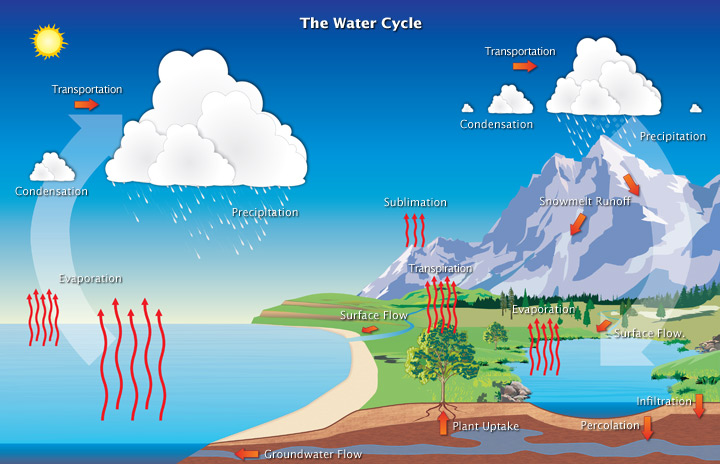
Earth'southward water continuously moves through the atmosphere, into and out of the oceans, over the country surface, and hush-hush. (Paradigm courtesy NOAA National Weather Service Jetstream.)
Studies have revealed that evaporation—the process by which water changes from a liquid to a gas—from oceans, seas, and other bodies of water (lakes, rivers, streams) provides nearly xc% of the moisture in our temper. Most of the remaining x% establish in the atmosphere is released by plants through transpiration. Plants take in water through their roots, then release it through small pores on the underside of their leaves. In addition, a very small portion of water vapor enters the atmosphere through sublimation, the procedure by which water changes directly from a solid (ice or snow) to a gas. The gradual shrinking of snowfall banks in cases when the temperature remains below freezing results from sublimation.
Together, evaporation, transpiration, and sublimation, plus volcanic emissions, account for almost all the water vapor in the atmosphere that isn't inserted through human activities. While evaporation from the oceans is the primary vehicle for driving the surface-to-atmosphere portion of the hydrologic bicycle, transpiration is also significant. For example, a cornfield 1 acre in size can transpire as much every bit four,000 gallons of water every solar day.
After the water enters the lower atmosphere, rising air currents carry it up, often high into the temper, where the air is cooler. In the absurd air, water vapor is more than likely to condense from a gas to a liquid to form cloud aerosol. Cloud droplets tin grow and produce precipitation (including rain, snow, sleet, freezing rain, and hail), which is the primary mechanism for transporting water from the atmosphere back to the Earth'southward surface.
When precipitation falls over the land surface, it follows various routes in its subsequent paths. Some of it evaporates, returning to the atmosphere; some seeps into the footing as soil moisture or groundwater; and some runs off into rivers and streams. Almost all of the water eventually flows into the oceans or other bodies of water, where the cycle continues. At unlike stages of the cycle, some of the water is intercepted by humans or other life forms for drinking, washing, irrigating, and a large diverseness of other uses.
Groundwater is found in two broadly defined layers of the soil, the "zone of aeration," where gaps in the soil are filled with both air and water, and, farther downwards, the "zone of saturation," where the gaps are completely filled with h2o. The boundary between these 2 zones is known equally the h2o tabular array, which rises or falls as the amount of groundwater changes.
The corporeality of h2o in the temper at any moment in time is only 12,900 cubic kilometers, a minute fraction of Earth's full water supply: if it were to completely rain out, atmospheric moisture would embrace the Earth's surface to a depth of only 2.v centimeters. However, far more h2o—in fact, some 495,000 cubic kilometers of it—are cycled through the atmosphere every year. Information technology is every bit if the entire amount of h2o in the air were removed and replenished nearly 40 times a year.

This map shows the distribution of water vapor throughout the depth of the atmosphere during August 2010. Even the wettest regions would form a layer of h2o only 60 millimeters deep if it were condensed at the surface. (NASA image by Robert Simmon, using AIRS & AMSU information.)
Water continually evaporates, condenses, and precipitates, and on a global ground, evaporation approximately equals precipitation. Because of this equality, the total amount of water vapor in the atmosphere remains approximately the aforementioned over fourth dimension. All the same, over the continents, precipitation routinely exceeds evaporation, and conversely, over the oceans, evaporation exceeds precipitation.
In the example of the oceans, the continual excess of evaporation versus precipitation would eventually leave the oceans empty if they were not being replenished by additional means. Not only are they existence replenished, largely through runoff from the land areas, but over the past 100 years, they have been over-replenished: ocean level around the globe has risen approximately 17 centimeters over the grade of the twentieth century.

Bounding main level has risen both because of warming of the oceans, causing water to expand and increase in book, and because more water has been entering the body of water than the amount leaving it through evaporation or other ways. A main cause for increased mass of water inbound the ocean is the calving or melting of land ice (ice sheets and glaciers). Sea ice is already in the ocean, and so increases or decreases in the annual amount of sea ice do non significantly impact sea level.
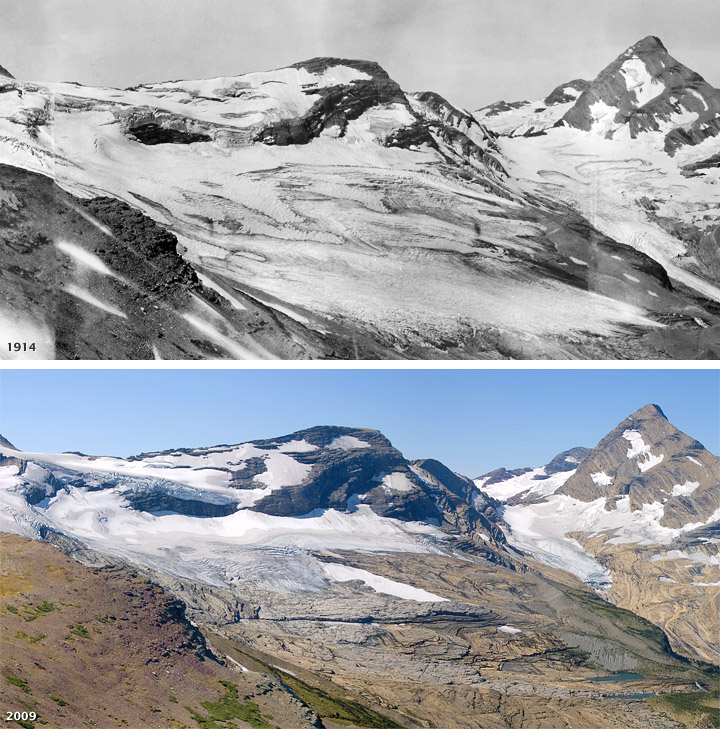
Blackfoot (left) and Jackson (right) glaciers, both in the mountains of Glacier National Park, were joined forth their margins in 1914, only have since retreated into separate alpine cirques. The melting of glacial ice is a major contributor to sea level ascension. [Photographs by E. B. Stebinger, Glacier National Park archives (1911), and Lisa McKeon, USGS (2009).]
Throughout the hydrologic bicycle, there are many paths that a h2o molecule might follow. Water at the bottom of Lake Superior may somewhen rise into the atmosphere and fall as rain in Massachusetts. Runoff from the Massachusetts rain may bleed into the Atlantic Ocean and circulate northeastward toward Iceland, destined to become part of a floe of ocean ice, or, after evaporation to the atmosphere and precipitation every bit snow, role of a glacier.
H2o molecules tin can have an immense variety of routes and branching trails that lead them again and once more through the 3 phases of ice, liquid water, and h2o vapor. For instance, the h2o molecules that once vicious 100 years ago as pelting on your corking- grandparents' farmhouse in Iowa might now be falling every bit snow on your driveway in California.
Source: https://earthobservatory.nasa.gov/features/Water/page2.php
0 Response to "Allows the Water to Return Again to the Earths Surface."
Post a Comment